
When I was in 4th grade, my father took me to a protest against the war in Afghanistan. I remember a Ziplock bag full of buttons that read “No Blood For Oil”, and I still have a t-shirt my dad gave me that has a picture of Earth on the chest and “THE WORLD SAYS NO TO WAR” on the back. 2010 was the first year that I was eligible to vote, and I registered and voted in the midterm election. The first president I voted for was the incumbent Barack Obama. The last president I protested was Donald Trump in January 2017. The day after his inauguration, I went to Washington, DC, in a bus full of New Yorkers and stood in a sea of women, queers, and allies. Prior to attending North Carolina Social Work Advocacy Day on March 5th, 2025, I would not say that I had ever participated formally in electoral politics beyond voting, but attending this remarkable event changed my perspective on what I had been doing all along.
NC Social Work Advocacy Day was organized by the National Alliance of Social Workers (NASW), and in some ways, it felt like a diplomatic version of a protest. I don’t think it was necessarily intended to be a protest; the gaggles of social workers and students who flooded the Senate and Legislative Office Building had requested meetings with representatives in advance and engaged in conversation, Q and A sessions, and policy briefs. Nonetheless, our presence felt both spontaneous and urgent as if we had suddenly appeared, like the unexpected rain, to politely demand for better governance.
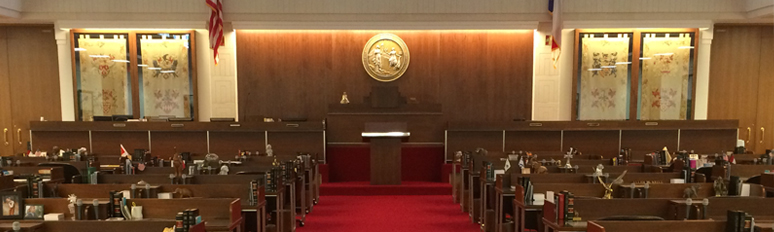
My peers and I had the opportunity to meet with our representatives, sit in on a committee meeting, and witness legislative hearings in both the North Carolina Senate and House of Representatives. I was struck by how the rug on the floor of the Senate chamber looked a lot like a Dragon Ball from the classic 90s TV show, Dragon Ball Z. But most striking was the degree of procedural formality that characterized the House and Senate meetings and how that structure framed what appeared to be open contempt between the Democratic and Republican representatives. One Senator was absent from the hearing I attended, and his name had to be called three times every time a vote was counted. This may seem trivial, but it was just one of several quirky and redundant procedural practices that surprised me. The formality was less of a surprise than the combined awkwardness and yet practiced fluidity of the proceedings. Sitting on the wooden benches in the hybrid modern and neo-classical gallery overlooking the Senate floor, I contemplated the well-lubricated yet ineffectual cogs slowly rotating to reproduce a degrading polity that has rapidly become passé.
The most devastating event I experienced that day was in the committee meeting I attended, where I witnessed an affirmative vote for Senate Bill 227: Eliminating “DEI” in Public Schools (Berger, et al., 2025). At least 30 constituents crammed into the back of the committee meeting room to present 1-minute statements in opposition to the bill. Only one public commenter spoke to affirm it. They didn’t even need a formal vote. When it came time to yea or nay, the senators all yelled their decisions at once, and the majority Republican committee easily affirmed the bill, without a formal count. It will likely pass a vote in the Senate and ultimately be vetoed by Democratic Governor Josh Stein, and return to committee to start the cycle again (Cooper, C. A., 2024).
What did I feel? I felt a disarming elation at the novelty of being on official business at our State’s capital. I felt gratitude for the work of Senator Julie Mayfield, who has advocated for LGBTQIA+ rights in the face of overwhelming opposition. I felt glee, having the chance to nurture a budding friendship on the long drive to Raleigh and back. And mingling within all of that buzzy newness, I felt a misty resignation and implacable despair. Our political system does not function well. It is clunky– too fast in some ways and too slow in others. It is a giant roach trying to fit into a stylish suit; it is Kafkaesque. I’m glad I went. I understand better what I have been protesting since I was 9 and participating in since I was 18.
I hope that I am a social worker. I am certainly political. My body is political at least, according to our government. But to answer the question, do I consider myself a political social worker? In order to claim that title, I think I will have to engage in more advocacy work. Whether I have the stamina to be a consistent advocate remains to be seen, but I do not think that North Carolina Social Work Advocacy Day 2025 will be the last time I visit a center of legislative power on official business.
One of the things I struggle with, being from New York, New York, and living in Asheville, North Carolina, is the feeling that even after six years, I am still not totally at home. I am so grateful for the spaciousness of mind that I have been able to cultivate in this smaller, quieter, greener city. I am so blessed by the friends and neighbors whom I have met and all the plants I now know and can name. There is so much biodiversity in Appalachia. This spring, I eagerly await fragrant azaleas and the luminous, veiny orbs of pink lady slippers. But when I think about diversity, I do not think of Asheville. I think of New York. I think of my family and my Abuela and how funny she would think it is that I have traded mosh pits for moss gazing. I wish there were more Puerto Ricans in Asheville. I’ve made one Cuban acquaintance, and that’s the closest I’ve gotten. As much as I love it here, I don’t know if this is my forever home. I love so many people in Asheville and would fight for them, amplify their voices, and support the conditions for them to be heard, but sometimes I feel like disconnecting entirely. That in itself is my ethical issue. I believe I am deeply privileged and empowered. So, do I have an ethical obligation to use my privilege and power to effect positive change? I think the authors of my political social work textbook, Lane and Pritzker, would argue the affirmative, as they posit, “Social workers in direct practice have a tremendous opportunity to use political skills to help their clients…. Policy-makers will not know what policies need to be changed, if they do not hear from direct practitioners and those who are directly impacted by the policies they create” (p. 469). I receive that as a call to action. Now I need to figure out what I have to offer.
I want to create a haven for people who disagree with the way society is structured. I told my new friend and he said, “That’s awesome, you should call it ‘A Haven For People Who Disagree with the Way Society is Structured’, and we should print t-shirts”. I imagine a grassy clearing outside of the city, but still accessible by public transportation. There is theater, and people of all kinds are invited to share their special interests and proposals for fun ideas to create a better world. I imagine that everyone has everything we need. I imagine that we are accepting of difference and embrace fruitful dialogue and thoughtful debate. I imagine that we are kind to all human and non-human beings, and everyone gets to print their own t-shirts with the slogan of their choice. Is there a conflict in my role as social worker and dispositionally inclined provocateur? Some may think so, but I don’t.
References
Berger, P., Lee, M. V., and Overcash, B. (2025). Senate Bill 227: Eliminating DEI in Public Schools. General Assembly of North Carolina Session 2025.
Cooper, C. A. (2024). North Carolina Is a Purple State. In Anatomy of a Purple State: A North Carolina Politics Primer (pp. 20–28). University of North Carolina Press. http://www.jstor.org/stable/10.5149/9781469681740_cooper.7
Lane, S. R., & Pritzker, S. (2017). Political social work: Using power to create social change. Springer.
Comments from contest judge Zackary Vernon: “We Should Print T-shirts” provides a candid and stirring first-hand account of our democratic process, showcasing its potential while also not shying away from its shortcomings.
